The Signal We Could Hear
but Never Read
For sixty-five years we have swept the sky for a whisper of company. The hard part was never hearing them — it's understanding what they say.
The probability of success is difficult to estimate; but if we never search, the chance of success is zero.
On the night of August 15, 1977, no human being heard a thing. The Big Ear radio telescope at Ohio State swept a patch of the constellation Sagittarius, dumped its numbers onto a computer printout, and went on with its survey. The signal that would become the most famous seventy-two seconds in the history of the search for alien life passed unnoticed — recorded in faint ink on fanfold paper, waiting.
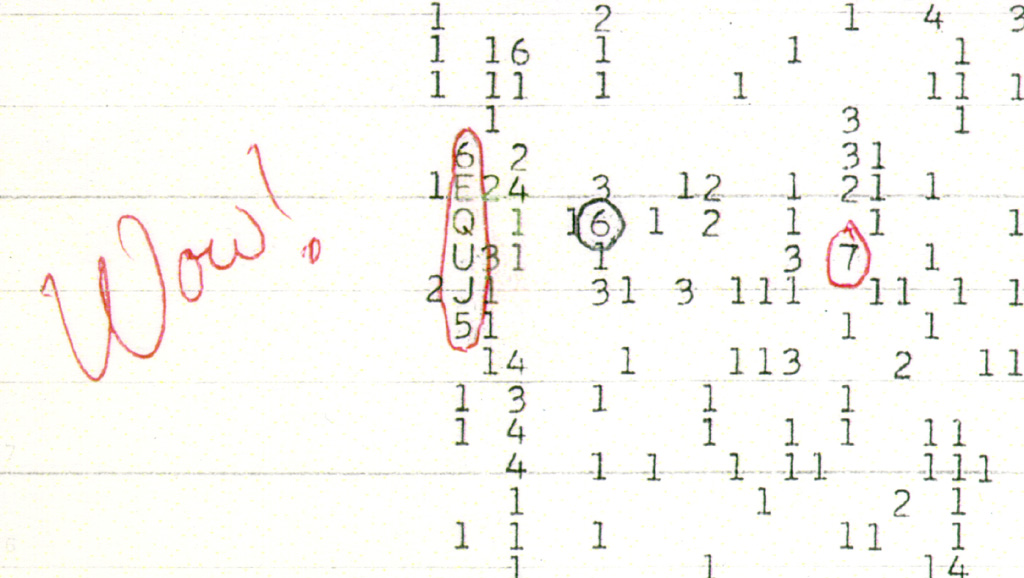
Days later, a volunteer astronomer named Jerry Ehman was leafing through the printouts. A column of mostly low numbers — the ordinary hiss of the universe — suddenly spiked: 6EQUJ5. He circled it in red pen and wrote a single word in the margin.
Wow!
That word became the signal's name, and the story we usually tell about SETI — the Search for Extraterrestrial Intelligence — is the story of that moment: the lonely watcher, the unexpected spike, the thrill of maybe. It's a story about detection. But detection, it turns out, is the easy part. The genuinely unsettling question in SETI isn't whether we'll ever hear something. It's whether, if we did, we could ever understand a single word of it. This is a post about that gap — the chasm between hearing a signal and reading it — and about the strange, beautiful, slightly mad project of trying to talk back.
How to Eavesdrop on a Galaxy
The modern search has a precise birthday. In September 1959, two Cornell physicists, Giuseppe Cocconi and Philip Morrison, published a short paper in Nature with a deceptively simple argument: if anyone out there wants to be heard across interstellar distances, radio is the cheapest way to do it, and there is one frequency they'd be foolish not to use — 1420 MHz, the note that neutral hydrogen sings on its own.
Hydrogen is the most abundant stuff in the universe, and a quirk of quantum mechanics makes a hydrogen atom occasionally flip the spin of its electron and emit a photon at exactly 1420 megahertz — the famous "21-centimetre line." Every radio astronomer in the cosmos, whatever their biology, would know this frequency. It's a natural meeting point: a channel any two strangers could agree on without ever having met. The engineer Bernard Oliver later gave it a lovelier name — the "water hole," the quiet band between hydrogen and hydroxyl, the two pieces of a water molecule, where water-based life might gather to drink and talk. (It's poetry, and worth flagging that some astronomers think 1420 MHz is actually a poor choice precisely because the galaxy is so noisy with natural hydrogen there.)
That paper landed at exactly the right moment, because a young radio astronomer had already, independently, decided to point a telescope at the stars and just listen.
In the spring of 1960, at Green Bank, West Virginia, Drake aimed an 85-foot dish at two nearby Sun-like stars — Tau Ceti and Epsilon Eridani, both about eleven light-years away — and tuned near the hydrogen line. He called it Project Ozma, after the princess of a land "far away, difficult to reach, and populated by exotic beings." Almost as soon as he swung the dish to his second target, Epsilon Eridani, a strong, pulsed signal sent the chart recorder's pen flying. Hearts pounded. It vanished, came back ten days later — and proved to be a passing aircraft. The lesson arrived early and never left: the sky is full of false alarms, and most of them are us.
The next year, Drake convened a tiny meeting at Green Bank to ask a bigger question: how many civilizations might be out there to hear? To give the conversation an agenda, he scribbled an equation on the blackboard. It has been scaring and seducing people ever since.
Read left to right, it's a chain of multiplications from the rate of suitable star formation, through the fraction of stars with planets, the number that are habitable, the fraction where life begins, becomes intelligent, and builds something detectable — and finally L, how long that detectable phase lasts. The ten or so people in that room — including a 26-year-old Carl Sagan, and the chemist Melvin Calvin, who learned during the meeting that he'd just won the Nobel Prize — jokingly called themselves the Order of the Dolphin.
The deep joke of the equation is that the left side has slowly come into focus while the right stays shrouded. Thanks to NASA's Kepler and TESS missions, we now know planets are nearly universal — essentially every star has them — so that term is close to 1. But does life begin? Does it think? Does it last? That half remains guesswork dressed in arithmetic. Drake himself liked to point out that the whole thing nearly collapses to its final term: N ≈ L. The number of voices in the sky depends, more than anything, on how long a technological civilization survives. If the answer is "not long," the galaxy is a graveyard of brief broadcasts that never overlapped.
That haunting possibility — a universe that should be crowded yet sounds empty — is the subject of its own Enlight post, The Great Silence. Here's the twist that one didn't dwell on, and that this post is built around: maybe the silence isn't an absence at all. Maybe the mail is arriving, and we simply can't read the envelope.
Everything That Looked Artificial
Before the hard problem, a humbling pattern. Over and over, SETI has found signals that looked designed — and over and over, nature or human technology turned out to be the author.
In 1967, a Cambridge graduate student named Jocelyn Bell Burnell noticed "a bit of scruff" on her chart recordings — a radio source pulsing with metronomic, 1.337-second regularity. Nothing natural was supposed to keep time that precisely. Only half-joking, the team labelled it LGM-1: Little Green Men. Bell Burnell herself doubted the alien hypothesis — the source kept sidereal time, marching with the stars, not with any earthly transmitter — and within months it was identified as the first pulsar, a spinning neutron star sweeping a lighthouse beam past Earth. A genuinely new object in the universe, mistaken at first for a message. (Her supervisor won the Nobel for it; she did not — a famous injustice.)
Which brings us back to that red-pen Wow! First, a correction to a myth: 6EQUJ5 is not a message. It isn't alien text and it isn't a code. It's a strip-chart of intensity. Big Ear measured how far the signal rose above the background noise and printed that strength as a single character — digits 1 through 9, then letters for anything stronger (A is 10, B is 11, and so on up). Read it as a curve, and the drama appears.
The signal climbed, peaked at about thirty times the noise, and faded — and the shape is the whole point. A source fixed in the sky, with Earth's rotation slowly carrying it through the telescope's beam, would trace exactly this rise-and-fall over about seventy-two seconds. It was narrowband, sat almost precisely on the hydrogen line, and looked, for all the world, like a beacon. And then it never came back. Despite hundreds of hours of follow-up over the decades, the Wow! signal has been heard exactly once.
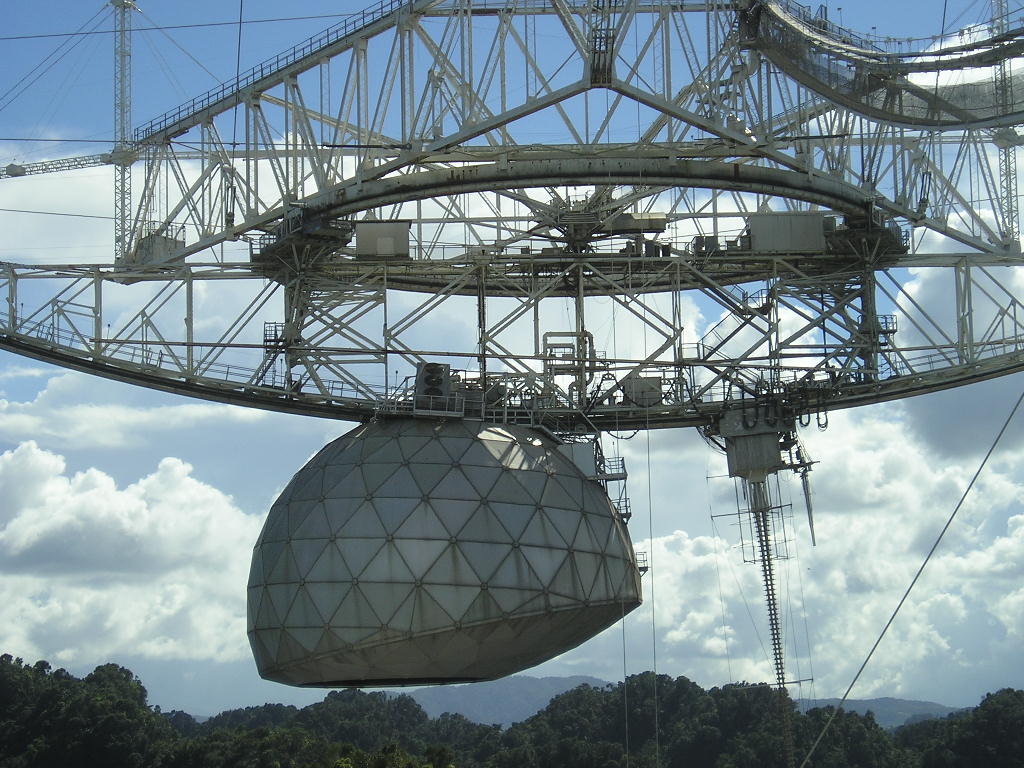
So what was it? The honest answer, after nearly fifty years, is we still don't know. A 2017 proposal blamed a pair of passing comets; the original Big Ear team and comet specialists dismantled it, noting comets don't shine at the hydrogen line and weren't in the right place. More intriguingly, in 2024 a team led by Abel Méndez at the University of Puerto Rico's Planetary Habitability Laboratory — trawling archived data from the late, great Arecibo dish — found faint Wow!-like blips near the hydrogen line and proposed a natural mechanism: a sudden flare from a magnetar briefly stimulating a cold cloud of interstellar hydrogen into a maser-like burst. It's the most complete explanation yet, and a 2025 follow-up even ruled out local TV interference. But Méndez is admirably blunt that it remains a hypothesis under peer review: in his own words, the results don't solve the mystery — they give us the clearest picture yet of what it was and where to look. Flag it honestly: leading natural candidate, not a confirmed verdict.

The pattern repeated in spectacular fashion twice more. Tabby's Star (KIC 8462852), about 1,470 light-years away in Cygnus, was caught by Kepler dimming by an astonishing 22% in deep, irregular dips — far too much for any planet. For a giddy year, "alien megastructure" was on the table: a half-built Dyson swarm, perhaps, harvesting its sun. Then the careful work landed. The dimming is wavelength-dependent — stronger in blue light than red — which is the fingerprint of fine dust, not an opaque solid. Megastructures don't filter by colour; dust does.
And in 2020, Breakthrough Listen announced BLC1 — a narrowband tone at 982 MHz, drifting in frequency just as a signal from an orbiting planet should, coming from the direction of Proxima Centauri, the very nearest star. By every old test, it was the best candidate ever found. The 2021 verdict, published across two papers in Nature Astronomy: not aliens. It was an "electronically drifting intermodulation product" — a ghost born from the harmonics of ordinary clock oscillators in human electronics, a machine somewhere on Earth quietly interfering with itself.
Pulsars, the Wow! signal, Tabby's Star, BLC1 — the recurring lesson of SETI is that "this looks artificial" almost always resolves into "this is natural, or it's us." It's not pessimism; it's discipline. Carl Sagan's standard — extraordinary claims require extraordinary evidence — is the immune system of the whole field. The hard part of finding a real signal is that a real signal has to survive the same gauntlet that has, so far, killed every candidate.
The Modern Ear
The instruments have grown almost unimaginably more sensitive. In July 2015 — on the anniversary of Apollo 11 — the investor Yuri Milner stood at the Royal Society in London beside Stephen Hawking, Frank Drake, and Ann Druyan to announce Breakthrough Listen: a ten-year, $100 million program to survey the million nearest stars, the plane of the galaxy, and a hundred nearby galaxies, using the Green Bank telescope, the Parkes "Murriyang" dish in Australia, and the MeerKAT array in South Africa. Its data are public. We are, right now, listening harder and across more of the sky than at any point in human history.
So suppose it happens. Suppose that tomorrow, one of those dishes catches a narrowband tone that drifts the right way, repeats on schedule, survives every filter, and resolves to a star with no satellites, no clock oscillators, no comets, no excuses. Suppose, at last, we are sure. Then comes the wall.
The Wall Between Hearing and Understanding
Detecting that someone is there and understanding what they're saying are not two stages of one task. They're two different tasks, and the second is brutally — perhaps fundamentally — harder. To see why, start with a result that sounds like a joke and is actually a theorem.
1. The better the message, the more it looks like noise
In 2004, three physicists — Michael Lachmann, Mark Newman, and Cristopher Moore — published a paper in the American Journal of Physics with a subtitle that belongs on a T-shirt: "Why any sufficiently advanced technology is indistinguishable from noise." Their argument is short and devastating.
Claude Shannon, the father of information theory, showed that the mathematics of information is identical to the mathematics of entropy — the same equation thermodynamics uses for disorder. A message carries the most information when it is maximally unpredictable: when knowing one part tells you nothing about the next. But "maximally unpredictable" is the precise definition of random noise.
So when you compress a signal perfectly — strip out every wasted bit, every redundancy, to cram the most meaning into the least energy — you are, by definition, sculpting it toward statistical randomness. Lachmann and his colleagues showed that an optimally efficient electromagnetic transmission is mathematically indistinguishable from the blackbody radiation of a warm object. From the outside, a perfectly written letter and a puff of heat look the same.
It means there's a cosmic catch-22. The only signals we can recognize as artificial are the redundant, repetitive, "inefficient" ones — the ones still carrying the structure that betrays a sender. A civilization a few centuries ahead of us, squeezing its bandwidth to the physical limit, would be broadcasting something we'd file under "background." We don't just risk missing alien signals. We risk listening to them for decades and calling them static.
2. There is no cosmic Rosetta Stone
Set the compression problem aside. Imagine we get lucky: a signal so gloriously redundant that it's obviously a message — patterns, repetition, structure, the works. Now we have to read it. And here we hit a wall that the entire history of human decipherment, our one real body of expertise, cannot scale.
Consider our greatest triumphs. The Rosetta Stone, unearthed in 1799, carried the same decree in three scripts — Egyptian hieroglyphs, Demotic, and Greek. Because scholars could already read the Greek, Jean-François Champollion had a key, and in 1822 he turned it. Or take Linear B, the script of Bronze Age Crete, cracked in 1952 by the architect Michael Ventris with no bilingual crib at all — a feat of pure cryptographic genius. And what did Ventris find when the symbols finally spoke? That the language underneath was Greek. Archaic, strange, but Greek nevertheless.
Sit with that. Even our hardest decipherment, the one with no Rosetta Stone, succeeded because the message was written by human minds, in a human language, about human things — kings and grain and sheep and oil. The code was alien; the world behind it was ours.
An alien signal offers no shared language, no shared body, no shared senses, and no shared world. It is Linear B with the Greek removed — and the Greeks removed, and Earth removed.
They might "see" in radio and "speak" in chemistry. Their mathematics might be unrecognizable; their logic might not be ours. There is no third column in Greek waiting at the bottom of the message. There is no shared object in the room to point at — and pointing, it turns out, is harder than it looks.
3. Even pointing at a rabbit doesn't work
In 1960 — the same year Drake first listened — the philosopher W. V. O. Quine published a thought experiment that should keep every would-be alien translator awake at night. Imagine a linguist visiting a people whose language shares nothing with any known tongue. A rabbit runs past; a native points and says "Gavagai." The obvious translation is "rabbit." But is it? The exact same scene is equally consistent with "undetached rabbit-parts," or "a temporal slice of rabbit-stage," or "lo, rabbithood again." No amount of pointing, no number of rabbits, can ever fully pin it down. Quine called this the indeterminacy of translation: meaning is underdetermined even between two humans standing in a field looking at the same animal.
If reference is that slippery between members of the same species — sharing a planet, a body plan, a sun — what hope is there across the light-years, with no shared field and no rabbit to point at?
The usual escape hatch is mathematics. Surely, the argument goes, prime numbers and π and the hydrogen line are universal — the one vocabulary any technological mind must share. It's a reasonable bet, and it's the one our whole outbound effort is built on (we devoted a whole post to humanity's four-thousand-year obsession with that one unkillable number). But notice what the bet actually buys you. Math can prove that a sender is intelligent. It can let you exchange "2, 3, 5, 7, 11." What it cannot obviously do is convey what they value, what they feel, what they mean. You can establish that someone is home without ever learning their name.
4. We can measure a language and still not read it
Here is perhaps the most exquisite version of the trap. The SETI researcher Laurance Doyle and his colleagues borrowed a tool from linguistics called Zipf's law: in any human language, if you rank words by how often they're used, the frequencies fall along a characteristic slope of about −1. It's a statistical signature of structured communication. Doyle's team applied it to animal signals and found that adult bottlenose dolphin whistles hit that same −1 slope — and, hauntingly, that dolphin infants "babble" with a flatter slope and converge on the adult value as they grow, just as human babies do.
This is genuinely powerful: we have tools that can look at a stream of alien symbols and tell us whether it has the statistical structure of a language — and even estimate how complex that language is. We could, in principle, prove that a transmission is richer and more layered than any human tongue. And we could still not understand one word of it.
Measuring that something is language is not the same as reading it. We can run the numbers on dolphin whistles and humpback song, confirm they're brimming with structure, and remain — after fifty years — unable to translate a single sentence. And dolphins are fellow Earth mammals. The most likely outcome of first contact may not be silence, and it may not be conversation. It may be a thick, beautiful, obviously meaningful book in our hands that we can prove is a book and can never open.
No one stared into this abyss harder than Stanisław Lem. In His Master's Voice (1968), a neutrino signal arrives from deep space, and the United States assembles thousands of its finest scientists to decode it. They extract a tantalizing fragment — a possible recipe for an exotic substance — and then they fail. Completely. They cannot even agree on whether it's a message at all, or whether they're merely seeing their own reflections in cosmic noise. Lem's verdict is bleak and bracing: a truly alien mind might transmit forever, and we might do nothing but read our own assumptions back to ourselves. It is the most honest SETI novel ever written, precisely because nobody wins.
It's worth pausing on the cheerful counter-example, because it shows exactly what we're missing. In Andy Weir's Project Hail Mary — which we've taken apart before — a human and an alien build a working shared language in a matter of days. It's a delight, and it isn't cheating, but look at why it works: Grace and Rocky are floating side by side. They can point. They can hold up the same object, run the same experiment, react in real time, and correct each other instantly. They share a physical "now." That feedback loop is the thing SETI can never have. Across interstellar distance, a single question and answer might take centuries; there is no pointing, no shared rabbit, no "do you mean this?" The warmth of Project Hail Mary is the warmth of presence. The chill of real SETI is the chill of a letter from someone who died before you were born.
The Messages We've Already Sent
None of this has stopped us from talking. If decoding their message is the wall, designing ours is the strange inverse art — sometimes called the anti-cryptography problem, because the goal is the exact opposite of a cipher: to write something a total stranger, with no key and no shared anything, could nonetheless crack.
The boldest attempt came in 1974. To celebrate an upgrade to the Arecibo telescope, Frank Drake and Carl Sagan composed the Arecibo Message and beamed it toward the globular cluster M13, some 25,000 light-years away. It was 1,679 bits long — and that number is itself the first clue.
Lay the bits out in that grid and an image emerges: the numbers one through ten, the atoms of DNA, the double helix, a little stick figure of a human, our solar system with Earth nudged up toward the figure, and the dish that sent it. It's a marvel of compression and a quiet confession of the whole problem: studies since have shown that a recipient with no human conventions would struggle to parse it correctly — even which way is "up" is a guess. We built a message designed to be decoded, and we're still not sure it can be.

The map on this blog's masthead
Three years later, in 1977, the two Voyager probes left Earth carrying the most famous bottles ever thrown into the cosmic ocean: the Golden Records. Curated by a team under Carl Sagan — including Frank Drake, the artist Jon Lomberg, and the creative director Ann Druyan, who recorded her own brainwaves and heartbeat onto the disc while, as the story goes, newly in love — each record holds music, greetings, and the sounds of a world. And on its cover is engraved a diagram you may recognize, because it sits at the top of this very page. It's the pulsar map — what Sagan's team intended as humanity's cosmic return address.
Here's the part almost everyone gets wrong. People assume the map is a set of arrows that "point home," like a treasure map. It's far cleverer than that. Fourteen lines radiate from a central point — our Sun. Each line points toward a pulsar, one of those metronomic neutron stars, and its length encodes that pulsar's distance. So far, so map-like. But marked along each line, in binary, is each pulsar's pulse period — its precise tick rate. And crucially, that period is written not in seconds (a unit no alien shares) but in multiples of the one clock the universe hands out for free: the 0.7-nanosecond beat of the hydrogen atom, the same 1420 MHz transition Cocconi and Morrison reached for in 1959.
That choice does two things at once. First, the unique combination of fourteen periods fingerprints our exact location — triangulate the pulsars and you've found the Sun. But second, and far more beautifully: pulsars slow down over time, at rates we can measure. So a future finder who compares the periods recorded on the plaque with the periods they actually observe can run the clock backward and calculate when the probe was launched. The map doesn't just say where we are. It says when we were — a message, a timestamp, and an address, all written in the one language we're betting is universal: the ticking of hydrogen.
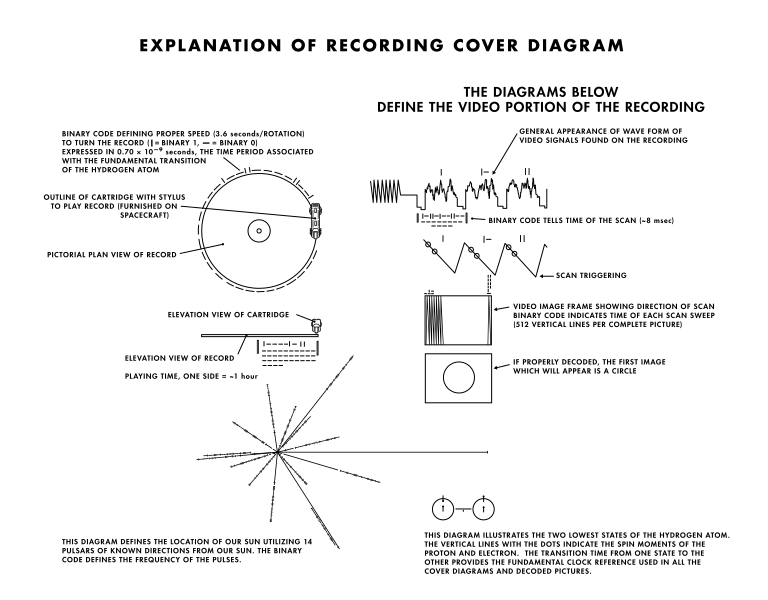
The Enlight masthead is the Voyager pulsar map: fourteen lines from the Sun, each a pulsar, each labelled with its period in units of the hydrogen line. It's the most optimistic object humans have ever made — a letter we sent knowing the recipient might not exist, might never find it, and might never read it. We sent it anyway. That's roughly the spirit of this whole blog.
The philosophical extreme of this art is a constructed language built from nothing but logic. In 1960, the Dutch mathematician Hans Freudenthal designed Lincos — Lingua Cosmica — a language that bootstraps itself from first principles: it begins by transmitting bare numbers, then teaches "greater than" and "equals" by example, then logic, then time, then — astonishingly — concepts like mass, behaviour, even ethics, each defined only in terms of what came before. Its modern descendants try to make the message a tiny self-explaining computer program. It's a heroic bet that meaning can be built upward from arithmetic with no foundation but reason itself. Whether a true alien would climb the same ladder we built is, of course, exactly the open question.
Carl Sagan put the real science into fiction in Contact (1985). A signal arrives from Vega, and the attention-getter is a sequence of prime numbers — exactly the "we are intelligent, this is not natural" beacon SETI actually expects. Then comes the lovely, defensible touch: nested inside is a rebroadcast of the first powerful TV signal to leave Earth — the 1936 Berlin Olympics — the aliens echoing our own transmission back to say we heard you. That part is real: our radio leakage really is expanding outward in a bubble. Deeper still lie blueprints for a Machine, layered like a palimpsest. The Machine and the famous coda hidden in the digits of π are Sagan's poetry, not physics — but the spine of the story, primes as a first hello and our own broadcasts as proof of contact, is as sound as SETI gets.
Should We Even Be Shouting?
There's a darker question underneath all this politeness, and it has lately stopped being academic. Listening is passive and safe. But should we transmit — deliberately announce ourselves to whoever's out there? This is the debate over METI, Messaging Extraterrestrial Intelligence, and it splits brilliant people down the middle.
The case against got its most vivid expression not in a journal but in a novel. In Liu Cixin's The Three-Body Problem — whose mathematical namesake we've already chased — a disillusioned astrophysicist, Ye Wenjie, broadcasts a message to the stars from a secret base. Years later, a reply arrives from a civilization called the Trisolarans. It is not a greeting. It is a warning, from a single pacifist on the other end:
Do not answer! Do not answer!! Do not answer!!!
— the Trisolaran listener's warning, The Three-Body ProblemTo reply, the message explains, is to reveal your location — and revealing your location is fatal. That premise blooms, across Liu's trilogy, into the dark forest hypothesis: if every civilization needs to survive, if resources are finite, and if you can never be sure a stranger across the light-years is friendly, then the safest move on detecting anyone else is to stay silent and, if you can, strike first. The universe, in this view, is not empty. It's a forest full of armed hunters, every one of them holding its breath. The silence we hear isn't absence. It's caution.
Real scientists make versions of this argument without the aliens. The late Stephen Hawking warned that contact with a more advanced civilization might go for us the way it went for Native Americans when Columbus arrived. The author and physicist David Brin argues that broadcasting is an irreversible decision affecting all of humanity, and that no small group of enthusiasts has the right to make it unilaterally on everyone's behalf. Even Frank Drake — the man who sent the Arecibo message — grew skeptical of shouting into the dark. And there's a stranger worry still, dramatized in Peter Watts's Blindsight (2006): what if the thing that answers isn't conscious at all? Watts imagines aliens of staggering intelligence but no self-awareness, and treats an incoming signal not as conversation but as a kind of attack — a costly intrusion demanding to be processed. In that vision, the most dangerous assumption isn't that aliens are hostile. It's that there's anybody "in there" to negotiate with at all.
The case for saying hello
The other camp finds all this a failure of nerve. Douglas Vakoch, who founded METI International, argues that deliberate, well-designed messaging is how a civilization grows up and joins the conversation — and that hiding is pointless, because we've been broadcasting by accident for a century. Every radar pulse and television transmission has been leaking into space since the 1930s; that bubble is already over a hundred light-years wide. The barn door, the argument goes, is open. Seth Shostak of the SETI Institute puts it bluntly: any civilization capable of crossing interstellar space to harm us could certainly detect our leakage already, so deliberate silence buys us nothing but cowardice. The Russian astronomer Alexander Zaitsev simply went ahead and did it, beaming messages toward nearby stars from a radio dish in Crimea.
And the shouting has, quietly, already happened. A 2008 transmission called "A Message From Earth" was aimed at a planetary system 20 light-years away. In 2017, METI International beamed a tutorial of mathematics and music — "Sónar Calling GJ 273b" — toward Luyten's Star, just 12.4 light-years off. If anyone's listening there, our reply is already a third of the way to its destination.
There's no consensus, and it would be dishonest to pretend otherwise. One side sees an irreversible gamble with the survival of the species, made by self-appointed volunteers; the other sees a door already open and a silence that's merely timid. Both argue from the same hard fact this whole post has circled: we are reasoning about minds we cannot model, across a gap we cannot bridge with feedback. We don't know if the forest is dark. We don't know if it's empty. We are deciding whether to call out into a darkness whose contents are, by the very arguments above, possibly unknowable.
Even Kubrick and Clarke felt the weight of it. In 2001: A Space Odyssey, the monolith dug up on the Moon does only one thing: the instant sunlight touches it, it screams a radio pulse toward the outer planets. It isn't a message to us. It's an alarm about us — a tripwire left by someone long gone, signalling that the apes have finally climbed high enough to be worth noticing. Whether that's a graduation or a death sentence, the film pointedly never says.
∿
So we return, finally, to Jerry Ehman at his kitchen table, red pen in hand. We've spent this whole post complicating his Wow! — showing that hearing is the easy part, that the real signal might hide in what we call noise, that even a confirmed message might be a sealed book, that talking back might be brave or suicidal and we honestly can't tell which.
And yet the dishes are still turning. We are still listening, still beaming primes and pulsar maps and Bach into the dark, still betting that hydrogen is a language and reason is a bridge. We do it not because we're sure it will work — by now you know it might not — but because of the line Cocconi and Morrison wrote at the very beginning, the one at the top of this page: if we never search, the chance of success is zero.
That's the whole audacity of it. We are a species that has, twice, engraved its home address on a golden record and flung it between the stars, knowing the recipient may not exist, may never find it, and may never read a word. The map on those probes — the one on this masthead — isn't really a message to aliens at all. It's a message about us: a small, brief, talkative civilization that looked up at an indifferent sky, suspected it might be alone or might be unreadable, and decided to say hello anyway.
- Cocconi, G. & Morrison, P. (1959). “Searching for Interstellar Communications.” Nature 184, 844–846. nature.com/articles/184844a0
- SETI Institute — The Drake Equation. seti.org/drake-equation-index · Project Ozma. seti.org/research/seti-101/project-ozma
- Lachmann, M., Newman, M. E. J. & Moore, C. (2004). “The physical limits of communication, or Why any sufficiently advanced technology is indistinguishable from noise.” American Journal of Physics 72, 1290. arxiv.org/abs/cond-mat/9907500
- Méndez, A. et al. (2024). “Arecibo Wow! I: An Astrophysical Explanation for the Wow! Signal.” arXiv:2408.08513. arxiv.org/abs/2408.08513 · phl.upr.edu/wow
- Smith, S. et al.; Sheikh, S. Z. et al. (2021). The BLC1 papers. Nature Astronomy 5. Analysis paper · Breakthrough Listen summary
- Boyajian, T. S. et al. (2016). “Planet Hunters IX. KIC 8462852 — Where’s the Flux?” MNRAS 457, 3988. academic.oup.com
- Doyle, L. R., McCowan, B., Hanser, S. F. et al. — Information theory applied to animal communication (Zipf & entropy analyses). Acta Astronautica & SETI Institute. seti.org
- NASA / JPL — The Voyager Golden Record: contents & the pulsar map. voyager.jpl.nasa.gov/golden-record
- Breakthrough Listen — Breakthrough Initiatives. breakthroughinitiatives.org
- Quine, W. V. O. (1960). Word and Object — the “gavagai” thought experiment. MIT Press.
- Freudenthal, H. (1960). Lincos: Design of a Language for Cosmic Intercourse, Part I. North-Holland.
Fiction discussed: Sagan, Contact (1985); Weir, Project Hail Mary (2021); Lem, His Master’s Voice (1968); Liu Cixin, The Three-Body Problem (2008, trans. Ken Liu 2014); Watts, Blindsight (2006); Clarke & Kubrick, 2001: A Space Odyssey (1968). Charts of the water hole, the compression limit, and Zipf slopes are schematic illustrations of the cited results.