The Three-Body Problem:
When the Universe Refuses to Be Solved
A 300-year mathematical nightmare that broke Newton's calculus, launched chaos theory, and inspired one of the greatest sci-fi novels ever written.
In 1687, Isaac Newton published the Principia Mathematica and handed humanity the keys to the cosmos. His law of universal gravitation and his freshly invented calculus could predict the motion of two bodies — a planet and a star, a moon and its world — with astonishing precision. Closed-form solutions. Clean ellipses. Mathematical perfection.
Then someone asked: what about three?
That question has haunted physics for over three centuries. The three-body problem — predicting the motion of three objects interacting through gravity — is one of the oldest unsolved problems in mathematics. Not because we're not clever enough, but because the universe itself has made it structurally unsolvable.
Two Bodies Dance. Three Bodies Fight.
Newton's calculus is a precision instrument built for pairs. Two gravitating bodies — say, the Sun and Earth — reduce to a single elegant differential equation. The solution is a conic section: an ellipse, a parabola, or a hyperbola. You can write down a formula that gives you the exact position at any time t, a billion years from now. Done.
Add a third body and the mathematics detonates. Instead of one equation, you get eighteen coupled differential equations (three bodies × three spatial dimensions × two for position and velocity). Each body's trajectory depends on the positions of the other two, which themselves depend on the first. Every tug reshapes every orbit, simultaneously, continuously.
Imagine two dancers waltzing — graceful, predictable, locked in rhythm. Now throw a third dancer into the space. Every step any one of them takes pulls the other two off balance, and their corrections create new disruptions. The feedback loops become irreducible. No formula can collapse this into a single, tidy answer.
Newton's worry was about more than just abstract mathematics — it was existential. If the solar system was inherently unstable, its continued existence required either a mathematical proof of stability or a divine hand. Newton chose the latter. Not from laziness, but because his tools genuinely couldn't settle the question.
The Art of the Beautiful Cheat
If you can't solve a problem exactly, the next best thing is to solve it approximately — and know exactly how approximate your answer is. That's perturbation theory: start with a solvable problem (two bodies), then treat the third body's influence as a small correction layered on top. Then correct the correction. Then correct that.
Think of it like calculating your monthly budget: nail down rent and groceries (the dominant terms), then add small adjustments for subscriptions, impulse buys, and that coffee habit you keep underestimating. Each layer refines the picture. You never get perfection, but you get arbitrarily close.
The Builders
Leonhard Euler formalizes perturbation methods for lunar and planetary motion. Working with successive approximations, he becomes the first to systematize the approach — even continuing to produce mathematics after losing his eyesight.
Alexis Clairaut applies perturbation methods to the Moon's orbit and briefly suspects Newton's inverse-square law might be wrong. Turns out he just needed more correction terms. Once he computed them, Newtonian gravity was vindicated.
Joseph-Louis Lagrange develops the method of variation of parameters — letting orbital elements drift slowly under perturbation. In 1772, he discovers five equilibrium points in the restricted three-body problem: the Lagrange points.
Pierre-Simon Laplace publishes the five-volume Mécanique Céleste, the grand synthesis. He shows that the solar system's apparent irregularities are periodic — they oscillate rather than accumulate. The system, he argues, is self-correcting. No divine intervention required.
Henri Poincaré enters a competition set by King Oscar II of Sweden to solve the n-body problem. His prize-winning paper contains an error — and while correcting it, he discovers that solutions exhibit sensitive dependence on initial conditions. He has effectively founded chaos theory, a century before we gave it that name.
Karl Sundman publishes a convergent power series solution to the three-body problem — technically "solving" it. Catch: the series converges so slowly it requires roughly 108,000,000 terms for practical accuracy. Mathematically victorious, computationally useless.
The Coldest Line in the History of Science
Laplace's Mécanique Céleste was a monumental achievement — a mathematical proof that the solar system was stable, that the wobbles and irregularities Newton worried about were self-correcting oscillations, not accumulating disasters. Where Newton had needed God as a cosmic reset button, Laplace's equations showed the machinery ran fine on its own.
The story goes that Napoleon Bonaparte — a genuinely scientifically literate leader who'd received a copy of the work — remarked to Laplace:
Laplace's reply has echoed through science for two centuries:
"Sire, I had no need of that hypothesis." — Pierre-Simon Laplace, c. 1802
Mic. Drop. It wasn't a theological attack — it was a mathematical statement. Newton's physics needed an external stabilizer because Newton couldn't prove stability. Laplace's perturbation theory could. The architecture of the solar system was self-sustaining. The hypothesis of divine intervention had become mathematically unnecessary.
There's a delightful coda. When Napoleon relayed this to Lagrange, the elder mathematician reportedly responded: "Ah, but that is a fine hypothesis — it explains so many things." Whether sincere, ironic, or diplomatically evasive, no one knows. The ambiguity makes it perfect.
Five Parking Spots in Space
Lagrange's 1772 discovery went far beyond theoretical elegance — he found that in any two-body gravitational system (like the Sun and Earth), there exist exactly five equilibrium points where a small third body can maintain a fixed position relative to the other two. No drifting. No spiraling away. Just... parking.
The trick is perspective. In a reference frame that rotates with the two large bodies, everything appears stationary. In this rotating frame, a small object feels three forces: gravitational pull toward the larger body, gravitational pull toward the smaller body, and centrifugal force pushing outward. The Lagrange points are where these three forces cancel exactly.
Think of it as a gravitational landscape — hills, valleys, and saddle points. The Lagrange points are the flat spots where a marble, placed perfectly, feels no net push in any direction.
The five Lagrange points of the Sun–Earth system. L1, L2, L3 lie along the line connecting the two bodies (unstable). L4 and L5 form equilateral triangles (stable). Distances are not to scale.
But not all parking spots are created equal. The key distinction is stable vs. unstable equilibrium.
Unstable (L1, L2, L3)
Imagine balancing a marble on top of a hill. Technically, the net force at the peak is zero — but any nudge sends it rolling away. Spacecraft at these points need regular station-keeping burns, like balancing a broomstick on your palm — constant tiny corrections.
Stable (L4, L5)
More like a marble in a wide, shallow bowl. Nudge it, and it rolls back — or more precisely, the Coriolis force (present in the rotating frame) deflects any drifting object into a slow loop around the Lagrange point. Objects don't sit still; they orbit the point in "tadpole orbits."
The Five Points, Up Close
Sits ~1.5 million km sunward of Earth, where the Sun's pull, Earth's pull, and centrifugal force balance. Provides a permanent, unobstructed view of the Sun — an early warning post for solar storms, detecting coronal mass ejections about an hour before they hit Earth.
Missions: SOHO · DSCOVR · ISRO's Aditya-L1~1.5 million km from Earth in the anti-sunward direction. Earth, Sun, and Moon all sit in roughly the same direction from here, so a single sunshield blocks all three heat sources — enabling deep-space telescopes to operate at temperatures near 50 Kelvin. The premium real estate of space astronomy.
Missions: James Webb Space Telescope · Gaia · Planck · EuclidLurks behind the Sun, directly opposite Earth. Beloved by science fiction as the hiding spot for a "Counter-Earth." In reality, it's gravitationally unstable and perpetually blocked from Earth's communications by the Sun. We've confirmed nothing is there. Sci-fi: 1, Reality: 0.
No active missions · Sci-fi favouriteForms an equilateral triangle with the Sun and Earth, 60° ahead in Earth's orbit. The Coriolis force in the rotating frame traps objects into slow loops around the point. Jupiter's L4 hosts thousands of Trojan asteroids, collected over billions of years. Earth has at least one confirmed Trojan here: asteroid 2010 TK₇.
Natural occupants: Trojan asteroids · Saturn's moon Telesto at Tethys L4The symmetric twin of L4, trailing 60° behind Earth. The same stability mechanism applies. In 1975, inspired by physicist Gerard K. O'Neill's vision of orbital colonies, the L5 Society was founded with the goal of building a permanent space habitat at the Earth–Moon L5 point by 1995. It merged in 1987 with the National Space Institute to become the National Space Society.
The L5 Society · Saturn's moon Calypso at Tethys L5The Cosmic Scenic Route
Beyond stationing spacecraft, Lagrange points unlock something transformative for mission design: the Interplanetary Transport Network (ITN). Near each Lagrange point, there exist natural "tubes" in phase space — called manifolds — that connect to other Lagrange points, like hidden highways linking mountain passes.
A spacecraft that enters one of these manifolds can drift from orbit to orbit using almost zero fuel — the gravitational landscape does the work. The trade-off? Time. These low-energy transfers can take months or years instead of days. But for robotic cargo missions, the fuel savings are enormous. NASA's GRAIL mission to the Moon took the slow route via Sun–Earth L1 and arrived with dramatically less fuel than a direct shot would have required.
Think of it as the difference between a highway (fast, fuel-heavy) and a river current (slow, nearly free). The ITN is the solar system's hidden river network, and Lagrange points are where the currents converge.
The Hidden Choreography of Three Bodies
Here's the cosmic twist: despite the general three-body problem being unsolvable, there exist very specific, very special configurations where three bodies can orbit in periodic, repeating patterns — cosmic dances that loop forever. These solutions are mathematically exact, physically valid, and breathtakingly beautiful. They're just extraordinarily rare.
Hierarchical Triples: How Nature Actually Does It
Nature overwhelmingly prefers one architecture: two bodies in a tight inner binary, with a third orbiting the pair at a much greater distance. The outer body "sees" the inner pair roughly as a single mass, reducing the problem to two nested two-body interactions. The wider the gap between inner and outer orbits, the more stable the system.
But there's a slow-motion assassin lurking within even stable hierarchical triples: the Kozai-Lidov mechanism, discovered independently by Yoshihide Kozai (1962) and Michael Lidov (1962). The outer body's gravity can gradually pump up the inner binary's eccentricity while decreasing its inclination, oscillating between the two over thousands of orbits. This slow cycling can eventually drive the inner pair into collision — and is now understood to be a key factory for binary black hole mergers detectable by LIGO.
The Exotic Choreographies
Now forget hierarchy. What if three comparable masses orbit in patterns where no one is the distant outsider? Mathematicians have discovered a hidden universe of such solutions — periodic orbits where three bodies trace intricate, repeating paths.
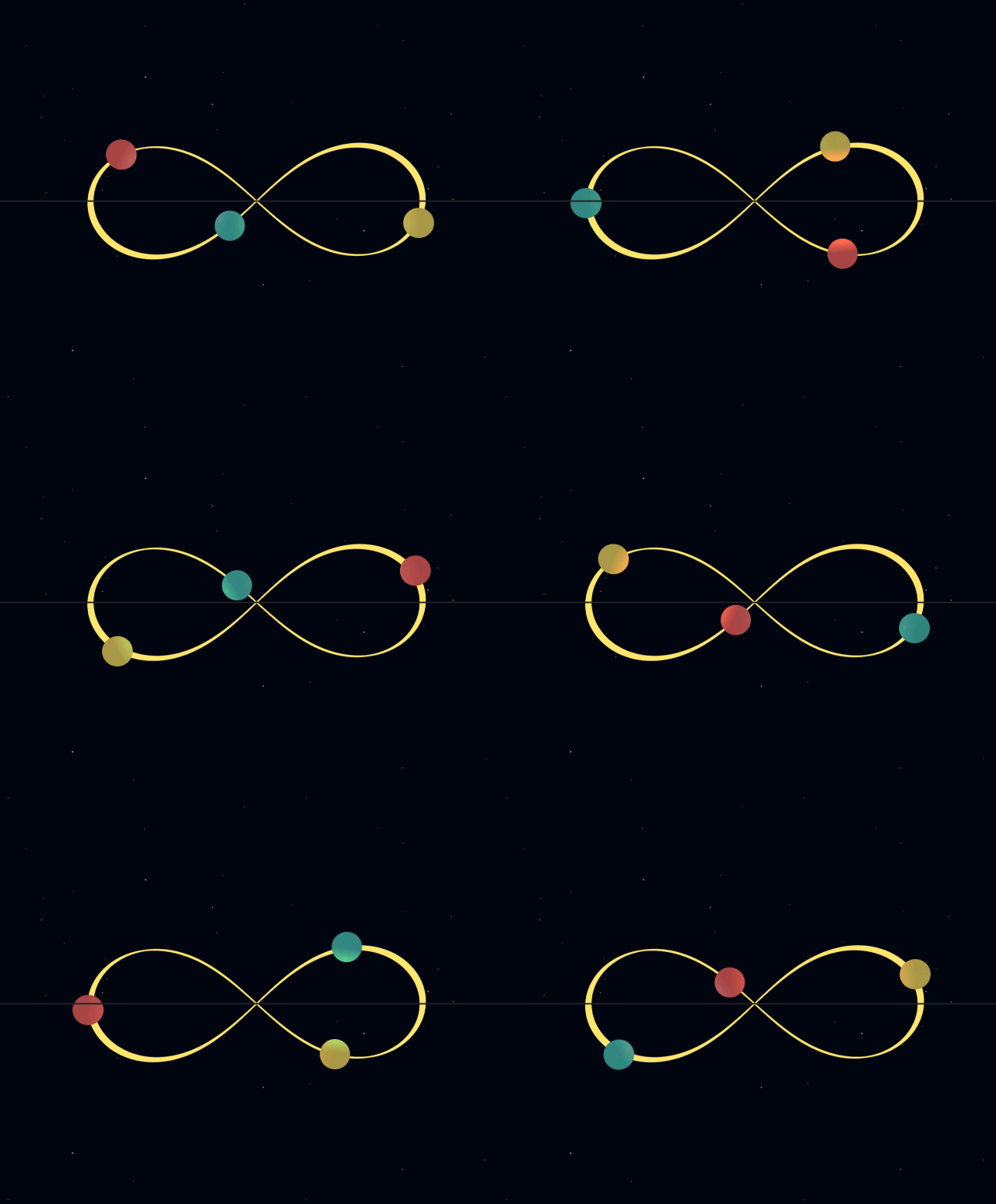
Figure-8
Three equal masses chase each other along a single figure-8 curve, equally spaced. Zero angular momentum. Proven to exist via variational methods — the laws of physics demand it as an action-minimizing path.
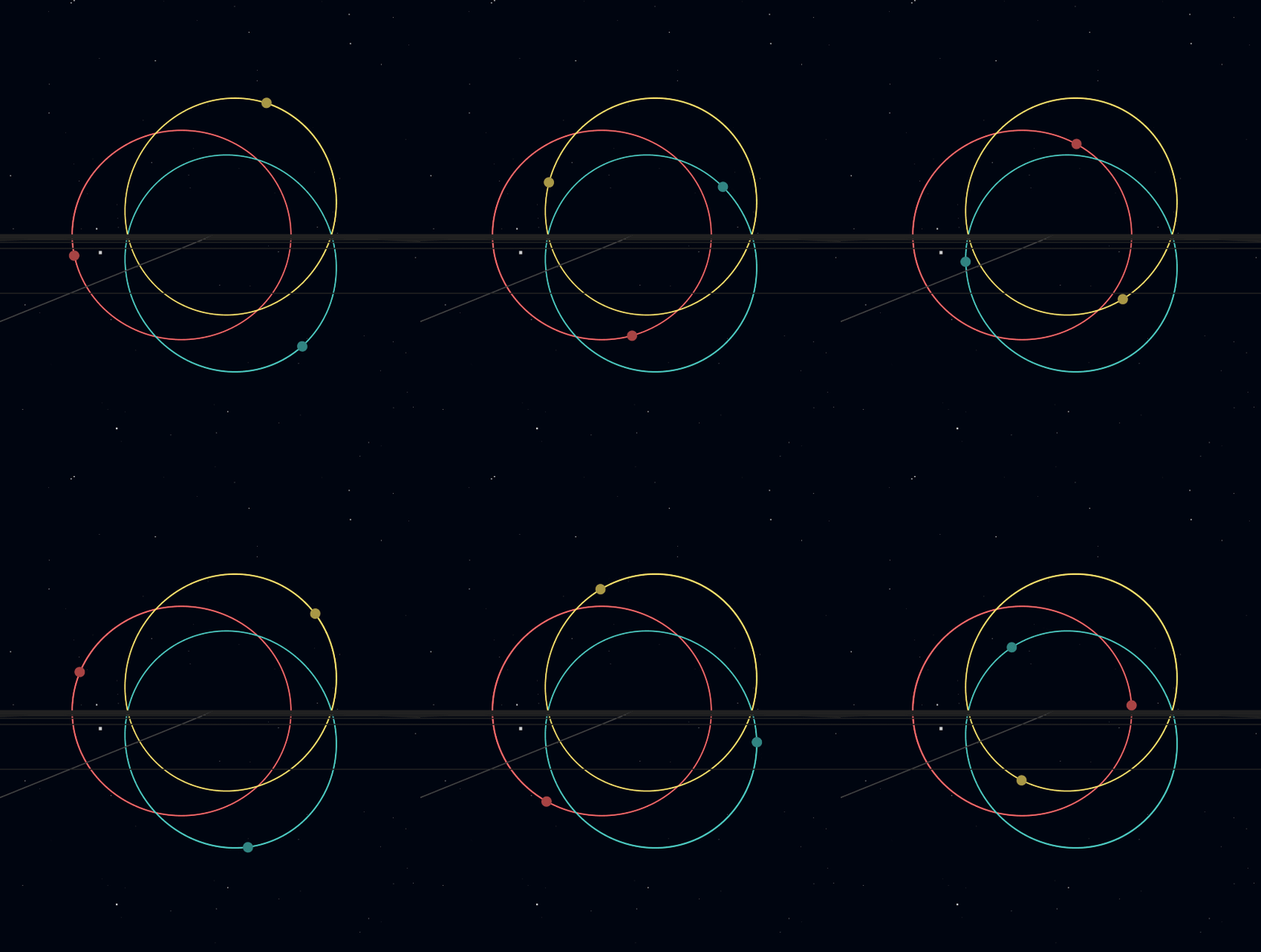
Lagrange Triangle
Three bodies at the vertices of an equilateral triangle, rotating rigidly. The OG configuration. Stable only under specific mass ratios — which is why Jupiter's Trojan asteroids exist but three equal stars in this pattern wouldn't last.
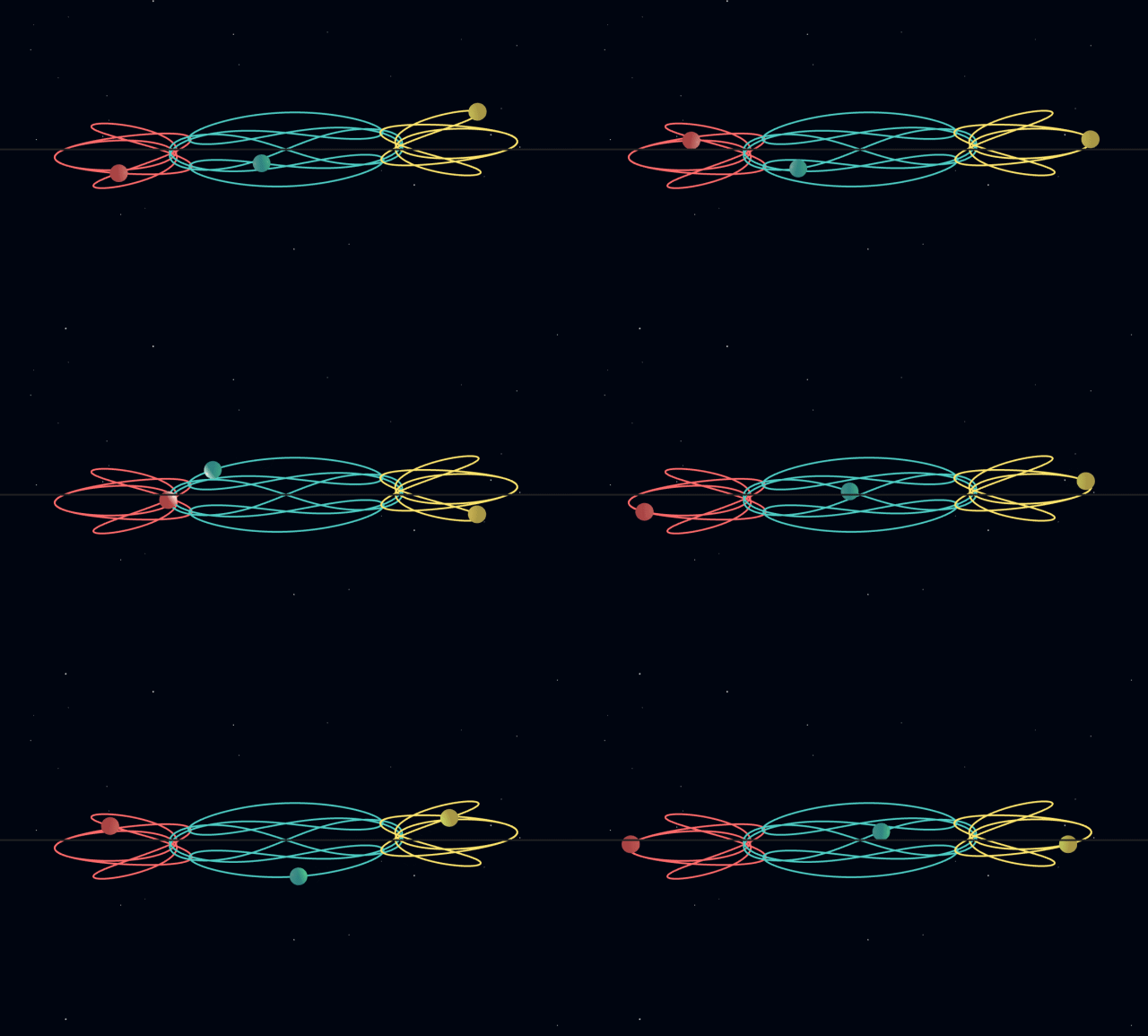
Butterfly
Bodies trace wing-like paths, alternating between close encounters and wide swings through a tight central region. One of 13 new families discovered in the Belgrade database.
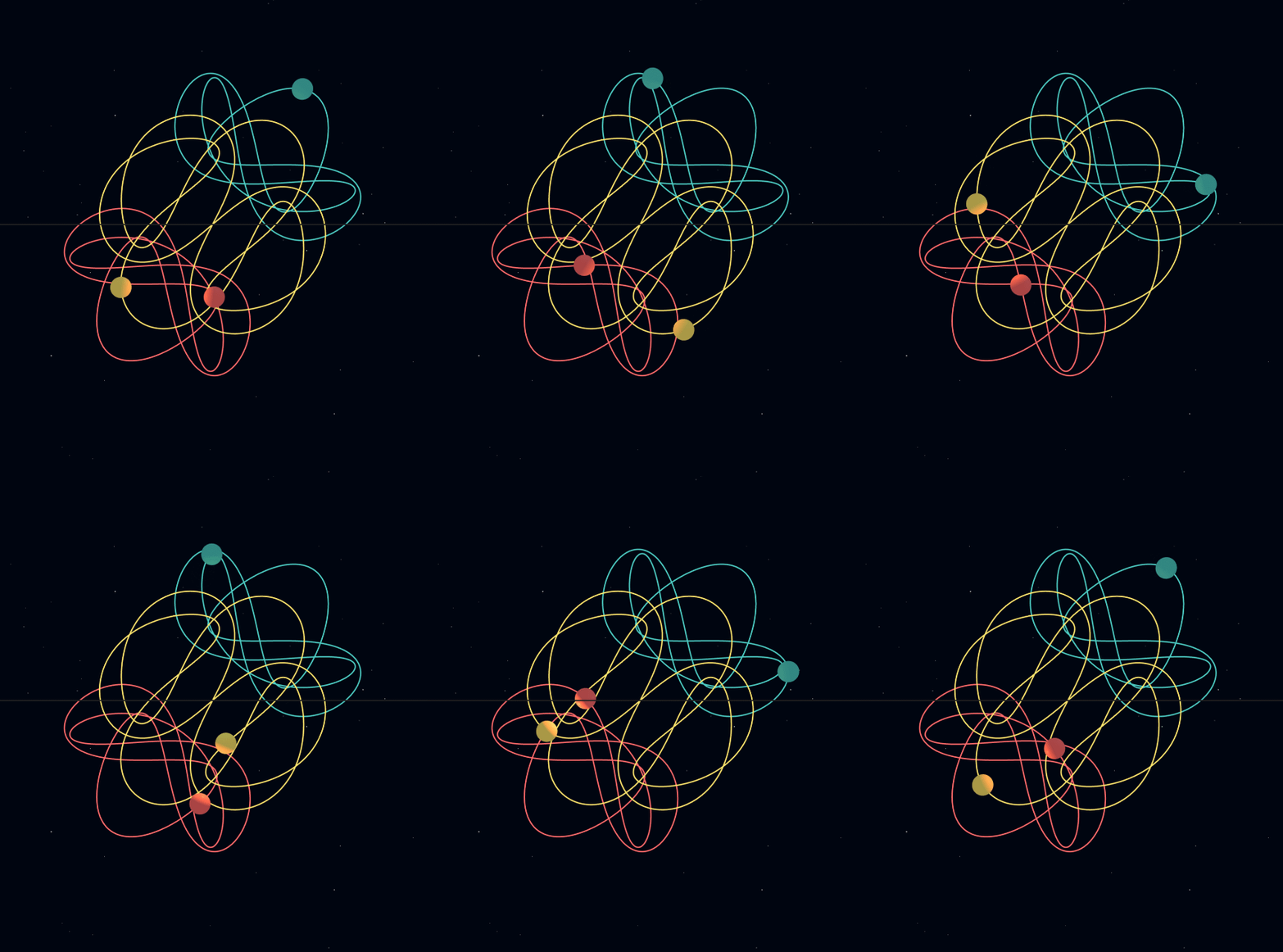
Yarn
Dense, tangled trajectories with many self-intersections — resembling a ball of yarn. Long periods, intricate braiding topology.
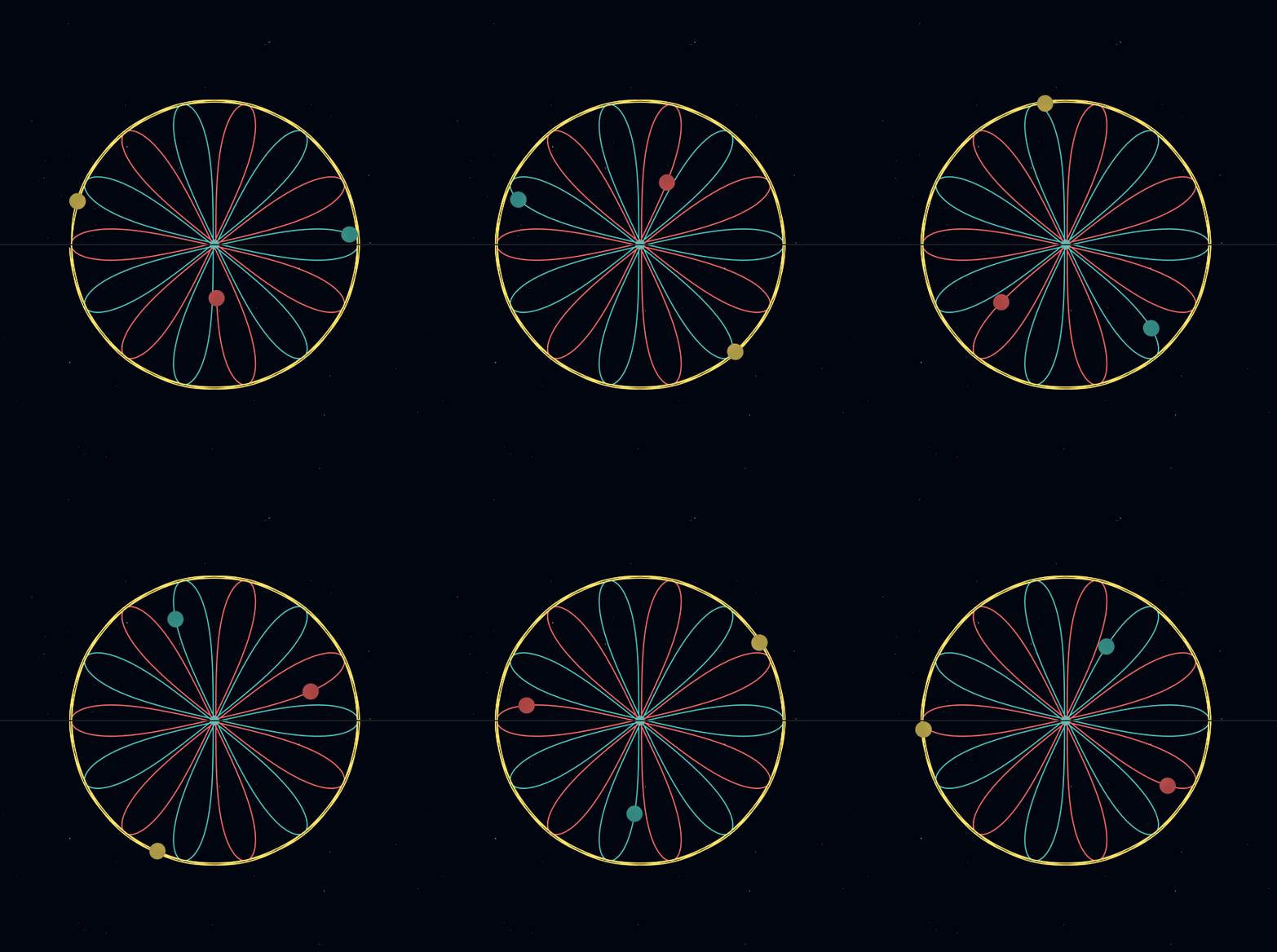
Broucke Orbit
One body oscillates through the center of mass while the other two swing around it. Broucke mapped whole families of these orbits, revealing connected branches and bifurcations.
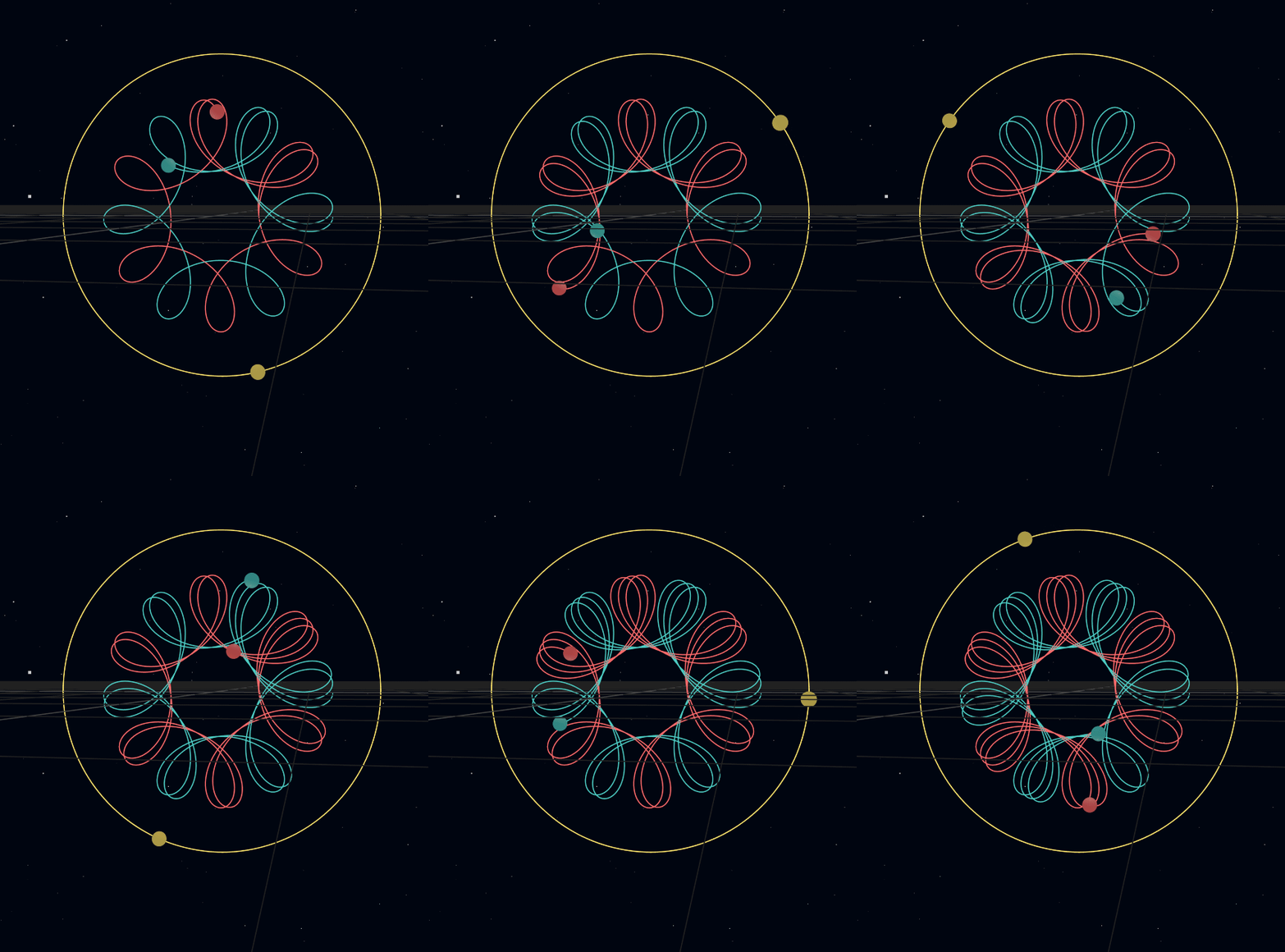
Hénon Family
Relatives of the figure-8, discovered by continuing the solution along parameter branches. As mass ratios or energy vary, the figure-8 distorts, gains loops, and bifurcates into entirely different orbit types — an evolutionary tree of periodic solutions.
Orbit visualisations courtesy of trisolarchaos.com
The Li–Liao Explosion
In 2017, Xiaoming Li and Shijun Liao at Shanghai Jiao Tong University detonated the field. Using Clean Numerical Simulation — ultra-high-precision integration with hundreds of significant digits instead of standard double-precision floating point — they discovered over 600 new families of periodic three-body orbits, later expanded to over 1,200.
Their key insight: standard numerical methods introduce floating-point noise that mimics physical instability. Many orbits dismissed by previous researchers as unstable were actually genuine periodic solutions, hidden behind computational rounding errors. It was as if everyone thought the desert had a handful of oases, and then someone flew overhead and found hundreds.
The Li–Liao database revealed that periodic three-body orbits are far more abundant than anyone suspected. They still occupy zero volume in the space of all possible initial conditions — almost no random configuration will produce one — but the variety is staggering.
Scaling Up: The N-Body Polygon Problem
If three bodies can dance, can four? Five? Eight? For any number n of equal masses, placing them at the vertices of a regular polygon and spinning the polygon at the right angular velocity produces an exact solution — a relative equilibrium. The mathematics guarantees it. The physics often destroys it.
An equilateral triangle (n = 3) is linearly stable for equal masses — Lagrange's original solution. A square (n = 4) is an exact solution but linearly unstable without help; perturbations deform it into a rhombus that keeps warping until something breaks. As you increase n to pentagons, hexagons, and beyond, the instability grows.
James Clerk Maxwell (1859) — the same Maxwell who unified electromagnetism — analyzed this problem for his Adams Prize essay on Saturn's rings. He showed that adding a sufficiently massive central body can stabilize these polygon rings. But the required central mass grows with n: by n = 7 or 8, no practical central mass can hold the polygon together. The choreography dissolves.
Think of it as a carousel: a few horses and the central pole holds everything rigid. Add too many horses and the structure flexes, wobbles, and eventually shakes itself apart — no matter how strong the pole.
Higher choreographies exist too. Carles Simó and others found four-body "super-eights," flower-petal patterns for five and six bodies, and increasingly intricate spirograph-like curves for larger groups. But each step up in n makes solutions harder to find, less stable, and more sensitive to perturbation. The combinatorial explosion of possible braids and the fractal narrowing of stability islands means these are mathematical truths the universe rarely instantiates.
From Equations to Entertainment
No discussion of the three-body problem is complete without Liu Cixin's novel The Three-Body Problem (2008, English translation 2014) — the book that transformed an unsolved math problem into a global cultural phenomenon.
Liu's premise is ruthlessly simple: what if a civilization lived inside a three-body system? The Trisolarans inhabit a planet in the Alpha Centauri system (a real three-star system), experiencing alternating "Stable Eras" of predictable climate and "Chaotic Eras" when gravitational dynamics fling them into wild orbital swings — freezing, scorching, or catapulting them unpredictably.
What makes it scientifically honest is that the Trisolarans can't solve the three-body problem — because it's actually unsolvable. Their brightest minds, across hundreds of civilization cycles, fail. The desperation for a stable home drives them to detect Earth's signal and launch an invasion, because a single-star system represents the gravitational stability they can never have.
The sequel, The Dark Forest, introduces the "Dark Forest Theory" as a solution to the Fermi Paradox — the universe as a dark forest where every civilization is a silent hunter, and broadcasting your location is suicidal. The logic rests on game theory: existential stakes, no repeated interactions, speed-of-light communication delays that prevent trust-building. It's become part of the genuine Fermi Paradox discourse.
The trilogy's third volume, Death's End, pushes into cosmological territory — civilizational warfare that collapses regions of space from three dimensions to two, inspired by string theory's extra dimensions. The fictional universe originally had 10+ dimensions, now reduced to three by aeons of cosmic conflict. Wild speculation, but informed wild speculation.
Both a faithful Chinese television adaptation (2023, Tencent) and a condensed Netflix series (2024, Benioff, Weiss & Woo) brought the physics to screen. The core adaptation challenge: Liu's novels are fundamentally about ideas, not characters. Every screen version must choose between honouring the physics and making audiences care about people.
The three-body problem has also escaped physics entirely. The phrase now appears in economics, geopolitics, and even relationship advice — any situation where three interacting agents create fundamentally unpredictable dynamics. When someone says "it's a three-body problem," they mean: this system is beyond simple prediction. Asimov's "Nightfall" (1941) explored similar terrain earlier — a civilization in a multi-star system that experiences darkness only once every 2,049 years, with catastrophic consequences — but Liu made the underlying physics the actual engine of his plot, not just the scenery.
The Library the Universe Ignores
The three-body problem occupies a unique place in science. Its equations are fully deterministic — given exact initial conditions, the future is uniquely determined. Yet the outcomes are practically unpredictable long-term. It's the universe being technically honest but practically evasive.
Three centuries of mathematicians — from Euler to Poincaré to Li and Liao — have mapped an extraordinary hidden landscape: fractal boundaries between order and chaos, islands of periodic stability in a sea of unpredictability, choreographies of stunning beauty that the laws of physics demand must exist. The figure-8, the butterfly, the yarn — they're theorems of gravity. Mathematical truths inscribed in the structure of Newtonian mechanics.
And yet, nature almost never uses them. Real astrophysical systems overwhelmingly settle into hierarchical triples or eject bodies until they reach stable binaries. The exotic choreographies have essentially zero probability of arising naturally, because their basins of attraction are infinitesimally thin.
It's as if the laws of gravity contain a vast, hidden library of beautiful dances — and the universe only ever plays the same three boring songs. The mathematicians found the library. Nature ignores it.
But perhaps that's exactly what makes it so remarkable. The three-body problem shows us that even in a deterministic universe governed by a single, simple force law — the inverse square — there is room for infinite complexity, irreducible unpredictability, and astonishing hidden structure. Three hundred years after Newton admitted defeat, we're still finding new rooms in the library.